


Modern Quality: The Final Verdict on ISO 9001 for Today's Market

So here we are: the end of our ISO 9001 journey together. You've weighed the pros, examined the cons, calculated the costs, and considered the competitive edge. Now comes the big question: Is ISO 9001 worth it for your SME in 2026 and beyond?
The short answer? It depends on where you're headed. But here's the thing: quality management isn't about ticking boxes or hanging a certificate on the wall. It's about building a business that consistently delivers, learns from its mistakes, and stays in the game when competitors stumble.
Let's bring it all together and look at what ISO 9001 really means for your business today: and tomorrow.
The Landscape Has Changed (And That's Good News)
Remember when ISO 9001 meant hiring consultants, drowning in paperwork, and praying you'd survive the audit? Those days are fading fast.
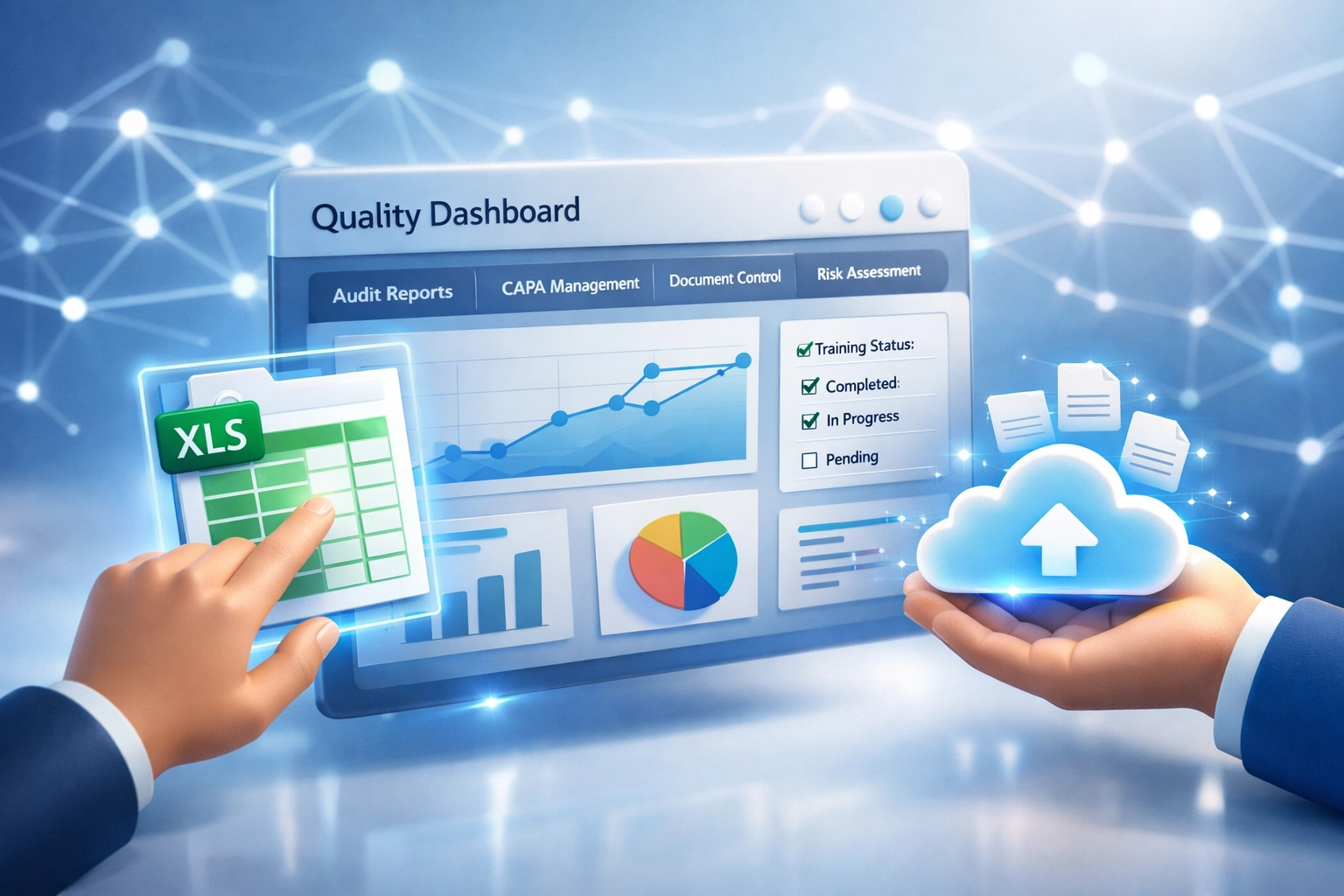
Modern tools have democratized quality management. You don't need enterprise-grade software or a dedicated quality team anymore. Excel templates, cloud-based QMS platforms, and even AI-powered compliance trackers mean that a three-person operation can maintain the same systematic approach as a 300-person company: just scaled appropriately.
The upcoming ISO 9001:2026 revision (due September 2026, according to ISO.org) demonstrates this evolution beautifully. Rather than mandating specific technologies or digital transformation requirements, it focuses on what actually matters: organizational culture, ethical behavior, and strategic alignment. The standard strengthens Clause 5.1.1 to explicitly require top management to promote a quality culture, recognizing that competitive advantage comes from embedding quality into your DNA: not just your documentation.
This is massive for SMEs. You're not being asked to adopt bleeding-edge tech or hire data scientists. You're being asked to think systematically about how you work and commit to continuous improvement. And now, the tools to do that are cheaper and more accessible than ever.
The ROI Equation: Where Do You Actually Stand?
Throughout this series, we've talked costs (£3,000–£15,000 for initial certification, plus annual surveillance audits) and benefits (tender access, customer confidence, operational efficiency). But let's be brutally honest about the return on investment.
ISO 9001 pays back fastest when:
You're tendering for contracts that require certification (often public sector or large corporate clients)
Your industry has high compliance expectations (manufacturing, healthcare, construction)
You're experiencing growth pains and need scalable systems
Customer complaints or quality issues are costing you repeat business
ISO 9001 struggles to justify itself when:
Your market doesn't value or recognize certification
You're pre-revenue or in very early startup phase
Your competitive advantage is speed-to-market over process consistency
You lack the leadership commitment to embed it properly
Here's the uncomfortable truth: if you pursue ISO 9001 purely as a marketing badge, you'll likely waste your money. The businesses that see genuine ROI are the ones that use the framework to actually improve operations: reducing waste, catching errors earlier, and creating knowledge that doesn't walk out the door when someone leaves.
A 2024 analysis by the International Organization for Standardization found that organizations with mature QMS implementations report 15–25% reductions in non-conformities and customer complaints over three-year periods (ISO.org, Survey of Management System Standard Users). That's not just certification: that's tangible operational improvement.
Start Small, Stay Sane
If you've decided ISO 9001 makes sense for your business, here's your pathway that won't overwhelm your team:

Month 1–2: Foundation Work Start with a gap analysis. You don't need a consultant for this: grab the ISO 9001:2015 standard (or wait for the 2026 version if you're starting fresh) and honestly assess where you already have processes versus where you're winging it. Most SMEs discover they're 40–60% compliant without realizing it.
Focus first on Clauses 4 (Context of the Organization) and 5 (Leadership). These establish why you exist and who's responsible. Get these right, and everything else flows more naturally.
Month 3–4: Document What You Actually Do This is where most businesses panic and create 200-page policy manuals nobody reads. Don't. Document the essential processes: how you handle customer orders, how you manage suppliers, how you deal with problems, how you measure performance.
Keep it lean. A well-structured Excel workbook or a simple cloud tool like Process Street or Notion can hold your entire QMS. We offer an ISO 9001 Document Readiness Review if you want expert eyes on your documentation before formal audit.
Month 5–6: Internal Audit and Management Review Run a practice audit yourself. Find the gaps. Fix them. Hold a management review meeting where you actually discuss whether your QMS is working or just existing.
This phase separates the businesses who'll succeed with ISO 9001 from those who'll struggle. If leadership treats this as a box-ticking exercise, your certification will be hollow.
Month 7–8: Certification Audit By now, you're living your QMS daily. The certification audit becomes a validation exercise rather than an interrogation. Book a pre-audit consultation with us if you want to rehearse with someone who knows what auditors look for.
The 2026 Revision: What It Means for You
If you're starting your ISO 9001 journey now, you might wonder whether to wait for the 2026 revision. Here's what you need to know:
The Draft International Standard has been approved, with final publication expected September 2026 and a three-year transition period through September 2029 (ISO.org). The changes are evolutionary, not revolutionary:
Stronger emphasis on quality culture and ethics (Clause 5.1.1)
Clearer risk and opportunity management structure (Clause 6.1 broken into sub-clauses)
Climate change considerations integrated into organizational context (Clause 4.1)
No mandated AI, digitalization, or supply chain requirements: these remain optional
What does this mean practically? Start with ISO 9001:2015 now if you're ready. The 2026 updates won't invalidate your work: they'll enhance areas you should already be addressing (leadership culture, risk thinking, environmental context). You'll have until 2029 to transition, and the core framework remains identical.

The decision not to mandate digital transformation or AI governance in ISO 9001:2026 is actually liberating for SMEs. You can adopt these technologies at your own pace, integrating them into your QMS as business needs dictate: not because the standard demands it. If you need AI governance specifically, that's what ISO 42001 is for, and you can layer it on top of your 9001 foundation later.
Quality Isn't a Destination
Here's the final thought I want to leave you with: ISO 9001 certification is not the finish line. It's the starting gun.
The certificate on your wall proves you've built the minimum viable system. The real value comes from using that system: questioning it, refining it, letting it evolve with your business.
The businesses that thrive with ISO 9001 are the ones that stop viewing it as compliance overhead and start seeing it as their competitive operating system. When a customer complaint comes in, your QMS tells you how to capture it, analyze it, fix it, and prevent recurrence. When you're scaling and hiring, your QMS provides the documented knowledge that turns new hires into productive team members faster. When a supplier fails, your QMS includes the risk assessment and contingency plan you need.
Quality management is how you stay in the game when markets shift, customers demand more, and competitors multiply. It's not glamorous, but it's durable.
Your Next Move
So what should you do on Monday morning?
If ISO 9001 makes strategic sense for your business, start with one simple action: map your core process end-to-end. Pick your most critical workflow: how a customer order moves from inquiry to delivery, for example: and document every step, decision point, and handoff.
That's your prototype. If you can do it for one process, you can do it for all of them.
If you're still uncertain, book a conversation with someone who can provide an honest, no-obligation assessment of whether certification makes sense for your specific context. At Expertise, we offer introductory business mentoring sessions precisely for this reason: sometimes you just need to talk through your situation with an expert who isn't trying to sell you something you don't need.
ISO 9001 isn't right for every business, and that's okay. But for the organizations where it fits: those ready to systematize, scale, and compete on consistency: it remains one of the most powerful frameworks available.
Quality isn't a destination. It's how you stay in the game.
Ready to explore whether ISO 9001 is your next strategic move?Explore our ISO services or get in touch to discuss your specific context. We're here to help you make the right call: whether that's pursuing certification or finding a different path to operational excellence.
Sources:
ISO.org (2025). "ISO 9001:2026 Draft International Standard"
ISO.org (2024). "Survey of Management System Standard Users"
Expertise Solutions UK internal consulting case studies (2024-2026)
Comments