


ISO 9001 Vs ISO 27001: Which Should Your Small Business Tackle First?

So you've decided your small business needs ISO certification. Brilliant move! But now you're staring at two of the most popular standards: ISO 9001 and ISO 27001: and wondering which one deserves your attention first.
Should you focus on quality management or information security? Will one give you a better return on investment? And honestly, do you even need both?
If these questions are swirling around your head, you're not alone. This is one of the most common dilemmas we hear from small business owners, and the good news is that there's a straightforward way to figure out your answer.
Let's break it down together.
What Exactly Are These Standards?
Before we dive into the comparison, let's make sure we're on the same page about what each standard actually covers.
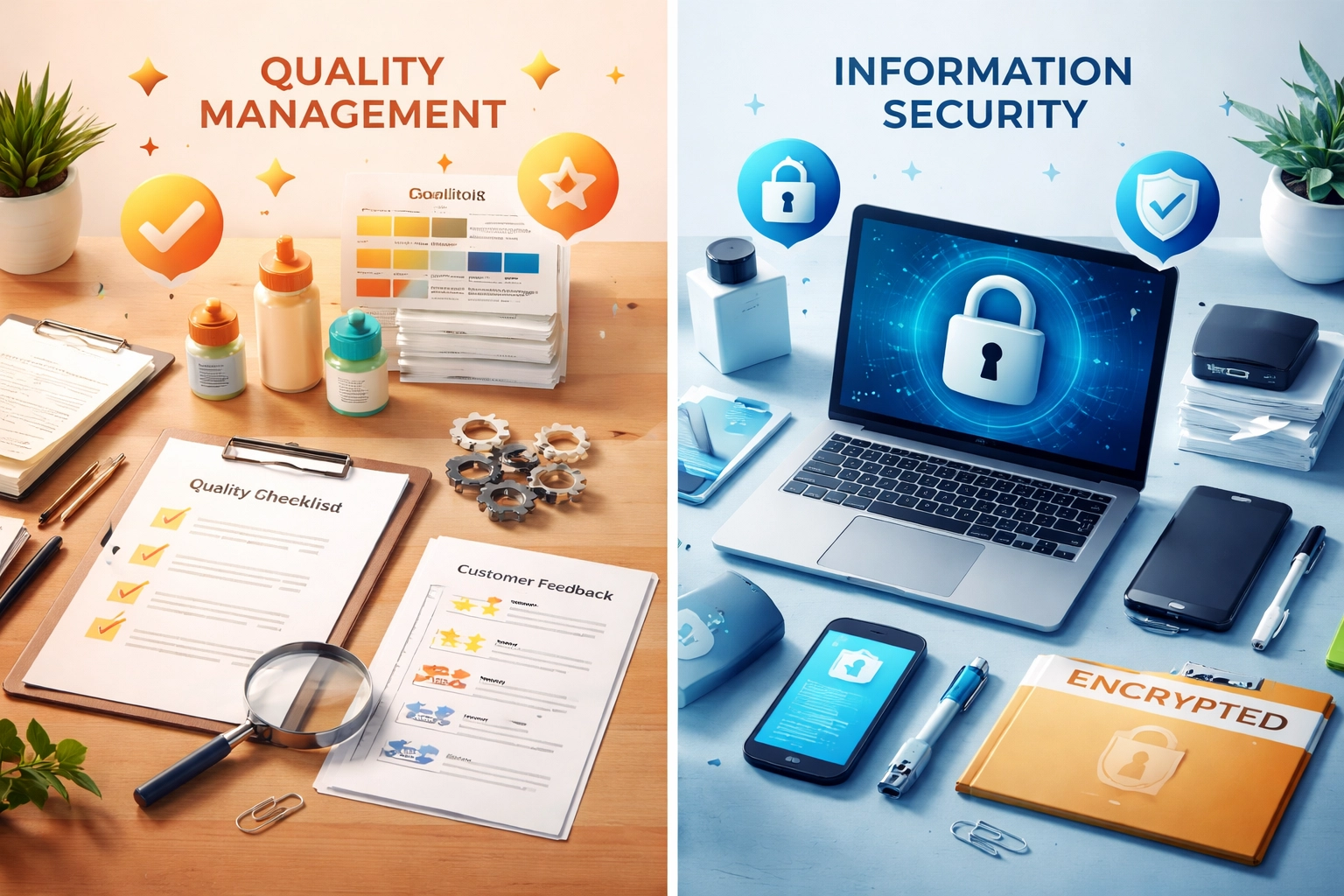
ISO 9001 is all about quality management. It helps you establish processes that consistently deliver products or services that meet customer expectations. Think of it as your blueprint for doing things right, every single time. It focuses on customer satisfaction, continuous improvement, and making sure your operations run like a well-oiled machine.
ISO 27001 is your information security management system (ISMS). It's designed to help you identify, assess, and manage risks to your data and information assets. If you handle sensitive customer information, financial data, or any digital assets that need protecting, this is the standard that keeps you secure.
Both are internationally recognised, both add credibility to your business, and both can open doors to new contracts and customers.
The Key Differences That Matter
Here's where things get interesting. While both standards share a similar structure (documented policies, internal audits, management reviews, and corrective actions), they have distinctly different focuses and requirements.
Focus and Scope
ISO 9001 centres on your business processes and how well you deliver value to customers. It asks questions like: Are you meeting customer requirements? Are you improving your products and services over time? Do you have clear processes that everyone follows?
ISO 27001 zeroes in on protecting information. It wants to know: What data do you hold? What are the risks to that data? What controls have you put in place to protect confidentiality, integrity, and availability?
Implementation Intensity
Here's something important to consider: ISO 27001 typically demands more upfront effort than ISO 9001.
Why? Because ISO 27001 requires you to implement specific preset controls from Annex A and provide documented evidence of compliance. You'll need comprehensive risk assessments and robust audit trails.
ISO 9001, on the other hand, takes a more process-oriented approach. You define your own controls based on what works for your business. This often makes it more accessible for businesses that are new to formal management systems.
Documentation Requirements
Both standards require solid documentation, but the nature of that documentation differs significantly.
For ISO 9001, you'll document:
Quality policies and objectives
Process maps and procedures
Customer feedback mechanisms
Continuous improvement records
For ISO 27001, you'll need:
Information security policies
Risk assessment methodologies
Asset inventories
Access control procedures
Incident response plans
How to Decide Which Comes First
Now for the million-pound question: which one should you tackle first?
The answer depends on your specific business circumstances. Let's walk through the key factors.

Factor 1: Your Primary Business Risk
Ask yourself: what keeps you up at night?
If your biggest concern is customer satisfaction, product quality, or service consistency, ISO 9001 should be your starting point. This is especially true if you've had complaints, quality issues, or inconsistent delivery in the past.
If you're worried about data breaches, cyber attacks, or the security of sensitive information, ISO 27001 needs to be your priority. The reputational and financial damage from a security incident can be devastating for small businesses.
Factor 2: Industry Requirements
Your industry often dictates the answer.
Go with ISO 9001 first if you're in:
Manufacturing
Construction
General professional services
Retail or wholesale
Food and beverage production
Go with ISO 27001 first if you're in:
Financial services
Healthcare
IT and technology
Government contracting
Legal services
Any sector handling personal data at scale
Factor 3: Customer and Contract Demands
What are your customers asking for?
If you're bidding on contracts that specifically require quality management certification, ISO 9001 is non-negotiable. Similarly, if you're working with larger organisations that mandate information security standards for their suppliers, ISO 27001 becomes essential.
Check your tender documents and customer requirements carefully. Sometimes the decision is already made for you.
Factor 4: Your Current Resources
Let's be practical about this. ISO certification requires investment: both time and money.
According to industry research, ISO 27001 implementation typically costs more and takes longer due to its technical requirements and the need for specialised security expertise. If your budget is tight, starting with ISO 9001 might give you a gentler introduction to formal management systems.
That said, if information security is your pressing need, delaying ISO 27001 to save money could end up costing you far more if something goes wrong.
The Integration Advantage
Here's some genuinely good news: implementing one standard first creates a solid foundation for the other.
Both ISO 9001 and ISO 27001 follow the same high-level structure (known as Annex SL). This means once you've built your documentation framework, established your internal audit processes, and got your management reviews running smoothly for one standard, you've done a significant chunk of the groundwork for the other.
Many small businesses find that their second certification takes roughly 40-50% less time and effort than their first. The learning curve is gentler, the processes are familiar, and you can reuse much of your existing documentation.

Our Recommendation
If you're still unsure, here's our straightforward advice:
Start with whichever addresses your most pressing business risk.
For most small businesses without specific regulatory or contractual requirements, ISO 9001 is the more accessible entry point. It helps you formalise your core business processes, improve customer satisfaction, and build a culture of continuous improvement. These foundations serve you well regardless of what comes next.
Once your quality management system is running smoothly and you've got resources available, you can layer ISO 27001 on top to address information security.
However, if you handle sensitive data, work in regulated industries, or have customers demanding security credentials, don't wait. ISO 27001 should be your first priority, even if it requires more initial investment.
Taking the Next Step
Feeling clearer about which direction to take? Brilliant!
The most important thing is to start. Certification might seem daunting, but thousands of small businesses achieve it every year: and so can you.
If you'd like expert guidance on your certification journey, our ISO 9001 Document Readiness Review and ISO 27001 Document Readiness Review services can help you understand exactly where you stand and what you need to do next.
Not sure which standard is right for your specific situation? Book a pre-audit consultation and let's talk it through together.
Which standard are you leaning towards? Drop us a message: we'd love to hear about your certification plans and help you make the right choice for your business.
Comments